“If we had not loved each other, none of us would have survived.” James Baldwin, Fire Next Time
“We are tied together in the single garment of destiny, caught in an inescapable network of mutuality. And whatever affects one directly affects all indirectly. For some strange reason I can never be what I ought to be until you are what you ought to be. And you can never be what you ought to be until I am what I ought to be. This is the way God’s universe is made; this is the way it is structured.” Martin Luther King, Jr., “Remaning Awake Through A Great Revolution”
Last spring, students in the lecture course, “Black Fire”, interviewed several African American alums about their experiences at the University of Virginia. A central theme in many of those reflections was how the African American student community relied on each other for intellectual and spiritual sustenance as well as cultural affirmation. Over the past few months, as the political upheavals in Ferguson, New York, and Oakland dominate not just national headlines but also our collective imaginations, my thoughts have frequently turned to the deep feelings of mutual obligation and kinship that bind “strangers” together, the sense of community that animate our politics. So, in honor of Kwanzaa and today’s principle, Umoja, we reflect on those pioneering black students who through individual and collective struggle contributed to the creation and advancement of the institutional infrastructure of what some of us simply refer to as “Black UVA.” When I say “pioneering black students,” I include those who laid the foundation for African American and African Studies, the Black Students for Freedom/the Black Student Alliance, Black Voices, the Divine Nine, OAAA, and other critically important institutions.
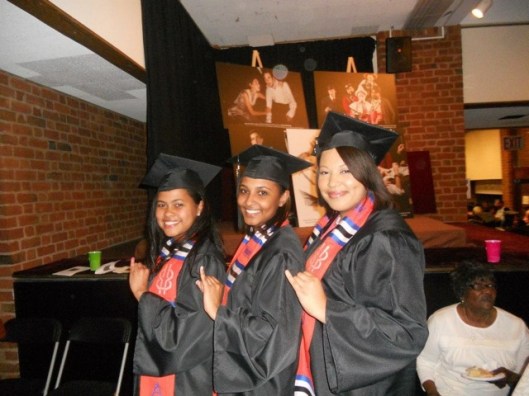
An important part of our work involves not just invoking the names of UVA’s black institution builders but capturing their voices. Six students, Alex McCargo, Naomi Himmelstein, Jordan Jackson, Julian Jackson, Shakye Jones, Ashley Wright did just that in an interview with a few of the charter members of the Theta Kappa Chapter of Alpha Kappa Alpha Sorority, Inc. As McCargo, Himmelstein, Jones, Wright, and the Jackson twins explained in their final group project:
“Taking advantage of the fortieth anniversary of the Theta Kappa Chapter’s establishment at UVa a few of our group members sat down and picked the brains of Theta Kappa’s (TK) charter members and other active members in the seventies. We interviewed seven women in total. Alva Cook, Lessie Oliver-Clark, Kim Crump, Linda White Hall and Regina Jackson-Watts were all active members and students at the University of Virginia in the seventies, and Hope Walton and Debra White-Coleman were Charter Members of TK.”
“As a group we felt it was imperative with the increasing influence that Black Greek Letter Organizations are having on the Black Community that what isn’t lost to the hands of time is the vast amount of knowledge that Charter Members of these organizations have to offer us. We were amazed at the amount of information that these women were able to recall. From where they attended the first grade to the block shows that they put on for the larger UVa community.”
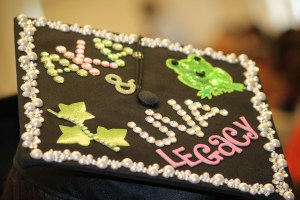
To their credit, the students spent a great deal of time collecting these oral histories and in the near future the entire transcript of their interviews will be posted.
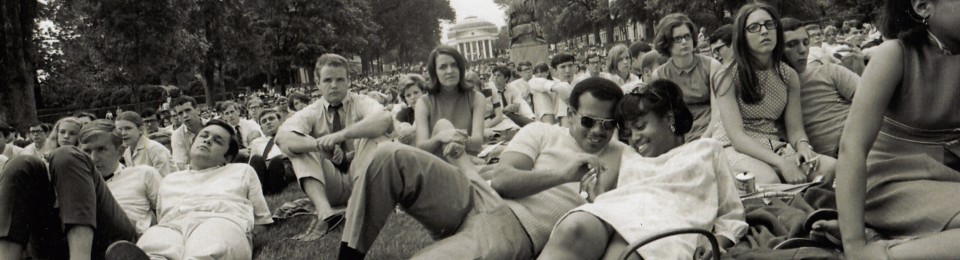
In light of today’s Kwanzaa theme of unity, I wanted to highlight a small section of their conversation with Regina Jackson-Watts, who graduated in the class of 1978. When discussing her background, Jackson-Watts explained: I’m a child of segregation and I went to an all black school until the fifth grade. We had the freedom of choice prior to that but my parents chose not to send us to an integrated environment because at that time there was a lot of turmoil.” Thanks to her supportive family and community, Jackson-Watts excelled in the classroom and decided to pursue her collegiate career at the University of Virginia. Upon her arrival, she discovered a small yet tight knit community of 500 black students: “I thought when I came to UVa there was a lot of cohesiveness among the black students. It made me feel loved. It made me feel like I could make it here.” Things were far from perfect at the University but black students found ways to create an alternative world for themselves. “I knew it was isolated,” Jackson-Watts says of the University. “But I never felt isolated because of the students here. I felt there was a lot of cohesiveness and I always felt like someone had my back.”
As repeated throughout their chat with the students, Jackson-Watts and the other interviewees found an important anchor in Theta Kappa, which was founded in 1974. To the students’ question regarding the role of Theta Kappa and other Black Greek letter organizations in contributing to the black community’s cohesiveness, Alva Cooper-Cook, Lessie Oliver-Clark, Kim Crump, Linda White Hall and Regina Jackson-Watts offered the following commentary:
Linda: Well for me I pledged Spring of ‘76 which is my second year, my third year I went into the commerce school so there wasn’t a lot of time to develop a network of social friends, so I relied on Theta Kappa and the brothers of Alpha for social life.
Leslie: Theta Kappa, in fact all the Black Greek Organizations, were focused more on service as opposed to the majority culture which was very much focused on social life activities. A lot of the focus was on drinking and things like that and the fraternity and sorority environment here for me as an African American kept me closer to the norms of community where I grew up with church and community service…
Kim: …I think Theta Kappa provided kind of a home base with other women who were positive influences in the community, good role models, just very wholesome. It really helped me feel a little bit grounded in school and to work on achieving my goals.
Leslie: You have to remember at the time we were here a tiny portion of the University, so even though people were divided in different organizations there was so few of us that you had no choice to really be supportive of one another. We got along well.
Kim: It was really the Greek organizations that kept the social life going…
Alva: …AMEN TO THAT! (laughs) Had it not been for the Greek organizations it would’ve been a very boring and mundane time at University of Virginia.
Of course, Theta Kappa and BGLOs were not the only institutions working in the vineyard, but their contributions are undeniable and deserve critical attention. Fortunately, over the past few years, we’ve had students like those mentioned above committed to understanding and documenting the past. Such work is mandatory in maintaining those strong bonds of unity and intergenerational connectivity.
 “Let others study us if they will, but self-definition is an intrinsic part of self-determination. It is we who must understand our families, our churches, our works of art, the schools our children attend, the economic, political, and spiritual structures which uphold—and oppress—the communities in which we live. It is we who must understand how all of these structures and institutions are related to our oppression and our struggle for liberation. It is we who must painfully diagnose our deepest illnesses and identify with great joy our most soaring aspirations towards new humanity.”

 Black Fire