UJIMA—Collective Work and Responsibility

20141116_1549091

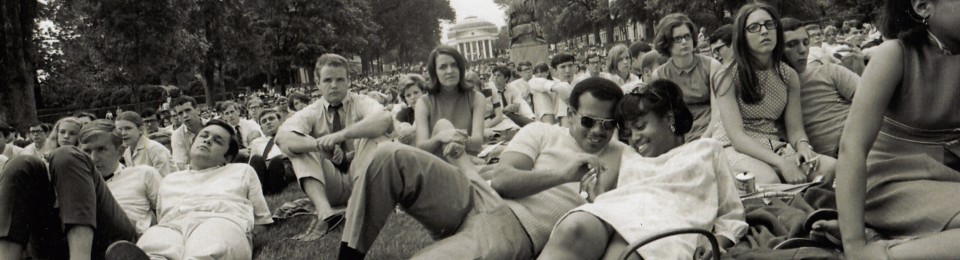
Looking forward to sharing the fruit of my collective work with Kevin Everson and Kahlil Pedizisai in 2015. This past November, Kevin, Kahlil, and I wrapped up shooting for a new film set in the spring of 1970 and based on student protest at UVA in the wake of President Nixon’s invasion of Cambodia and the murder of four Kent State students. The film tells the story of antiwar protest from the perspective of James Roebuck, the first African American to hold the position of Student Council president. Over a ten-day period of unprecedented student upheaval, Roebuck confronts a series of political challenges and existential dilemmas that engender a variety of human emotions. Roebuck is the quintessential “militant insider” whose cool temperament and ideological flexibility proves quite useful as his campus appears on the verge of imploding from within.

As was the case with Sugarcoated Arsenic, we hope that this film not only captures an important phase in the history of UVA but also provides a roadmap for young activists committed to creating a better world.

photo.JPG


Kujichagulia/Self-Determination

IMG_0431 “Let others study us if they will, but self-definition is an intrinsic part of self-determination. It is we who must understand our families, our churches, our works of art, the schools our children attend, the economic, political, and spiritual structures which uphold—and oppress—the communities in which we live. It is we who must understand how all of these structures and institutions are related to our oppression and our struggle for liberation. It is we who must painfully diagnose our deepest illnesses and identify with great joy our most soaring aspirations towards new humanity.”

“An embattled, colonized people need liberated grounds on which to gather, to reflect, to teach, to learn, to publish, to move towards self-definition and self-definition. Some of these grounds may be in the heart of contemporary white-controlled institutions but the experiences of the past few years indicate that there are far fewer grounds in such places than we would like to believe. Others stand in critical potentio on the contested setting of purportedly black controlled institutions. But such places must yet be moved firmly into the effective control of a struggle-conscious black leadership, and set in the direction of our needs. Still others, under such control are fighting to grow and develop into the full power and prospect they hold for our people. The vast majority of the black institutions we need are yet to be born. To live the truth is to join in the process of that birth, of that building.” Quotes from Vincent Harding, “The Vocation of the Black Scholar and the Struggles of the Black Community,” 1974